Vibe Coding with Gemini Code Assist
I’ve been thinking a lot about vibe coding and finally decided to give it a proper shot. I’ve toying with it on and off before, but never really finished a project. This past week, though, FOMO kicked in — so I committed to it, carving out just 20 minutes a day to see what would happen.
First question: what to create? I opted for something simple — a game. Pong felt perfect: it’s classic, visual, and achievable within small daily sessions. Plus, coding it in JavaScript meant I could host it for free on GitHub Pages and share it easily.
There’s also another reason for picking JavaScript: it’s one of the most common languages, and I’m pretty confident most LLMs are well-trained with it. That makes the back-and-forth with an AI smoother.
As for the AI, I went with Gemini Code Assist in VSCode. The main factor? It’s free, and Google is generous with the quotas:
60 requests per minute
1000 requests per day
A 1 million token context window for local code base
That’s plenty of room for simple vibe coding experiments.
Next step — getting started! I’m not exactly fluent in JavaScript. I can read and understand it well enough, but starting something from scratch still feels like a mountain to climb. That actually made this a great test case: to see how well an LLM can handle things when I guide it with the right vibe and clear instructions.
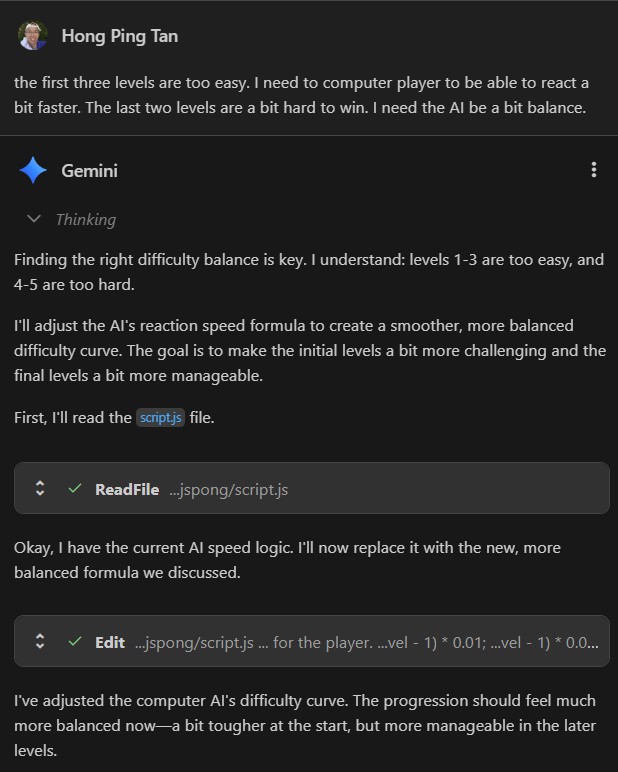
Unfortunately, Gemini Code Assist doesn’t keep a full chat history, so I can’t show my exact starting prompts. But they were nothing fancy — just a few simple requests asking the LLM to create a new game called JSPong, with some basic gameplay ideas. Things like having a computer AI player, defining how the ball moves, and how the game should progress through levels. One of the prompt I captured below on how requesting LLM to fine tune the computer player reaction time:
The game is live here in https://hongping.github.io/vibecoding-jspong/, and it is playable with keyboard. To note, though I did edit some of the code, but is mostly cosmetic and does not impact the game mechanics.
First Impressions
Overall, I’m impressed — though not entirely surprised. I’ve played around with this kind of coding flow before, especially using Claude’s artifact feature. Claude lets you share and even execute web-based code directly, which already felt like a glimpse of this “vibe coding” style — I just didn’t know there is a term for such flow.
I’ve also tried getting sample code from ChatGPT before, and it usually produces something close to what I have in mind. So I already had a certain amount of trust in LLM-driven code generation.
For this experiment, though, I went all in with Gemini Code Assist. I let it take over almost everything — generating code, committing changes, and even pushing updates. My role was more like a creative director, guiding the direction and letting the AI handle the hands-on work.
Reflections
If you’ve heard of mob programming, vibe coding feels almost identical — except this time, the LLM is the driver and you’re the navigator. You guide, it types. I think this kind of workflow is becoming inevitable as AI agents increasingly integrate into the programmer’s daily routine.
I don’t believe AI will replace programmers. What it does is ease the work. We still need to understand the generated code, review logic, and make corrections when things go sideways. The fundamental skill set doesn’t disappear — but those who can communicate effectively with AI will have a huge advantage in productivity and speed.
That said, there’s one thing I’ve started to worry about: overreliance. If we lean too much on LLMs, we risk forgetting the craft itself. I jokingly call this “AI Down Syndrome” — that moment when your AI assistant stops responding, and you suddenly feel helpless. I actually experienced it firsthand when Gemini Code Assist briefly stopped working, and I caught myself panicking a little.
So while it’s great to embrace these new tools, we also need to stay grounded — to make sure we can still stand on our own when the AI goes silent.
What’s Next…
For my next experiment, I’ll be testing out context handling — asking Gemini Code Assist to understand an existing framework and build something on top of it. Enough of my little detour into the web world; it’s time to head back to my core area: hardware verification.
Disclaimer 1: This blog post was drafted with the help of AI (ChatGPT) as well.
Disclaimer 2: Opinions expressed are solely my own and do not express the views or opinions of my employer.